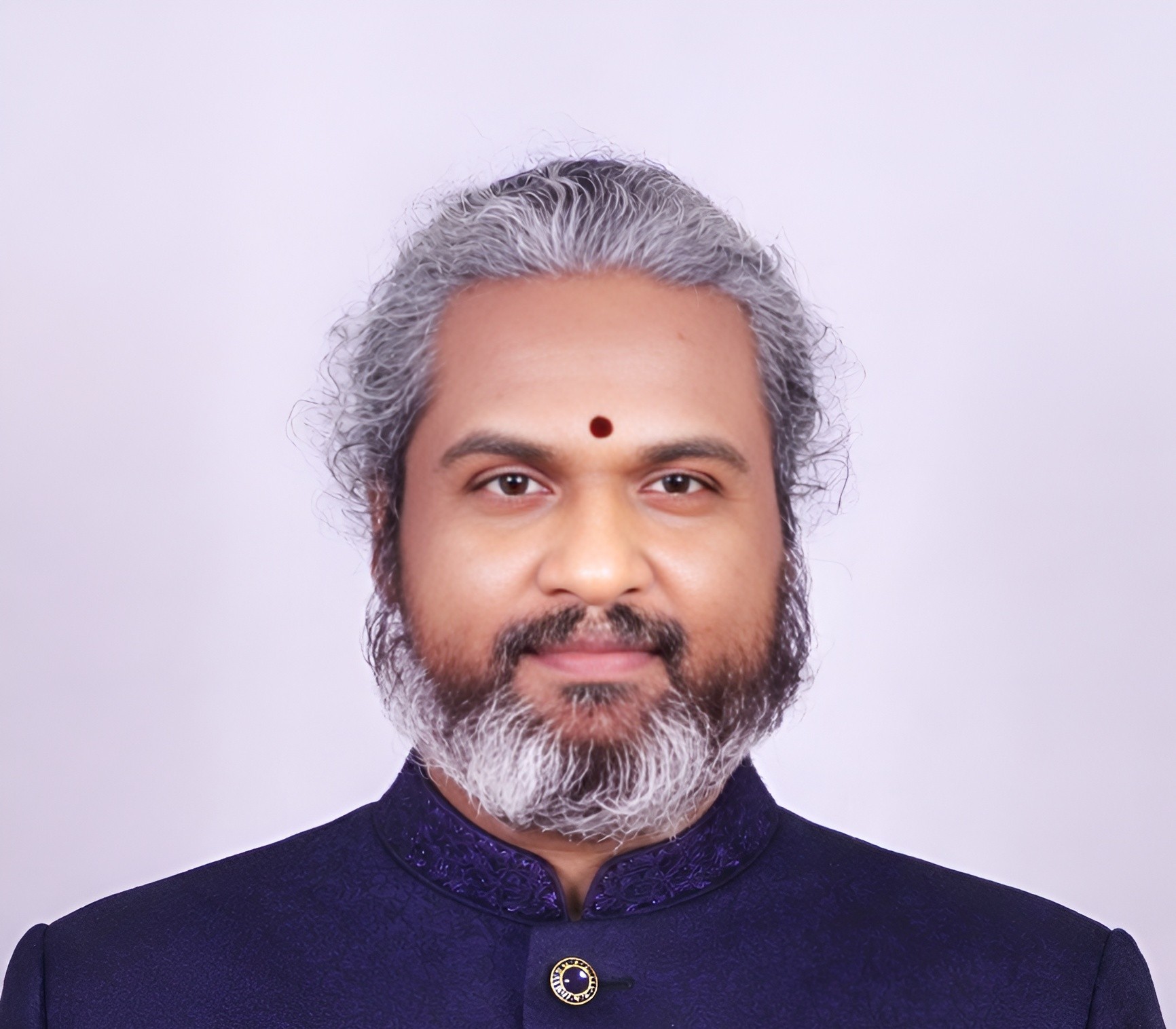
There are artists who paint what they see, and there are artists who paint what they feel. Synoj Sivan does both simultaneously, and that rare convergence is what has carried his work from a childhood home in Kannur, Kerala, to the auction rooms of Christie’s London and Sotheby’s, to the sacred walls of the Mookambika Temple Museum, and to galleries and exhibitions across four continents. His paintings do not simply depict Hindu mythology and Indian tradition. They inhabit it, capturing the weight of devotion, the texture of lived culture, and the luminous quality of a civilisation that has been telling its stories in colour and form for millennia. That he began this journey at the age of twelve, with watercolours and a sense of purpose most artists spend years searching for, makes the story all the more compelling.
BORN IN KERALA, DRAWN TO THE CANVAS: THE EARLIEST YEARS
Kerala has long nurtured artists with an instinct for colour, ritual, and the visual grammar of devotion. It is a landscape where temple murals, classical dance, and the ornamentation of daily life create an environment rich with aesthetic stimulus. For a child already inclined toward the image-making impulse, it was a formative world. Synoj Sivan began painting at twelve, working initially in watercolours before the medium’s delicacy gave way to his expanding ambition. Oil paint, with its capacity for layering, depth, and the kind of luminous realism that can make a painted figure seem to breathe, was the medium in which he would eventually find his fullest expression.
The influence that would most profoundly shape his technical approach came from an unlikely quarter: French Academic Realism. The tradition that produced artists capable of rendering skin, fabric, and light with an almost photographic precision gave Synoj the technical vocabulary to pursue his true subject matter, the gods, mythological figures, and everyday people of India, with a lifelike quality that invites not just observation but contemplation. What makes his work distinctive is not simply its technical accomplishment but the way it puts that accomplishment entirely in service of cultural meaning.
AN INTERNATIONAL DEBUT AT EIGHTEEN: THE MARK OF A PRODIGY
The art world is full of late bloomers. Synoj Sivan was not one of them. At eighteen, he conducted a solo international exhibition at the French Academic Realism, a milestone that would be remarkable for any artist but that, at that age, signals the kind of early mastery that only emerges when talent is matched by total commitment. The exhibition announced a painter who had already moved well beyond imitation and was speaking in a voice distinctly his own.
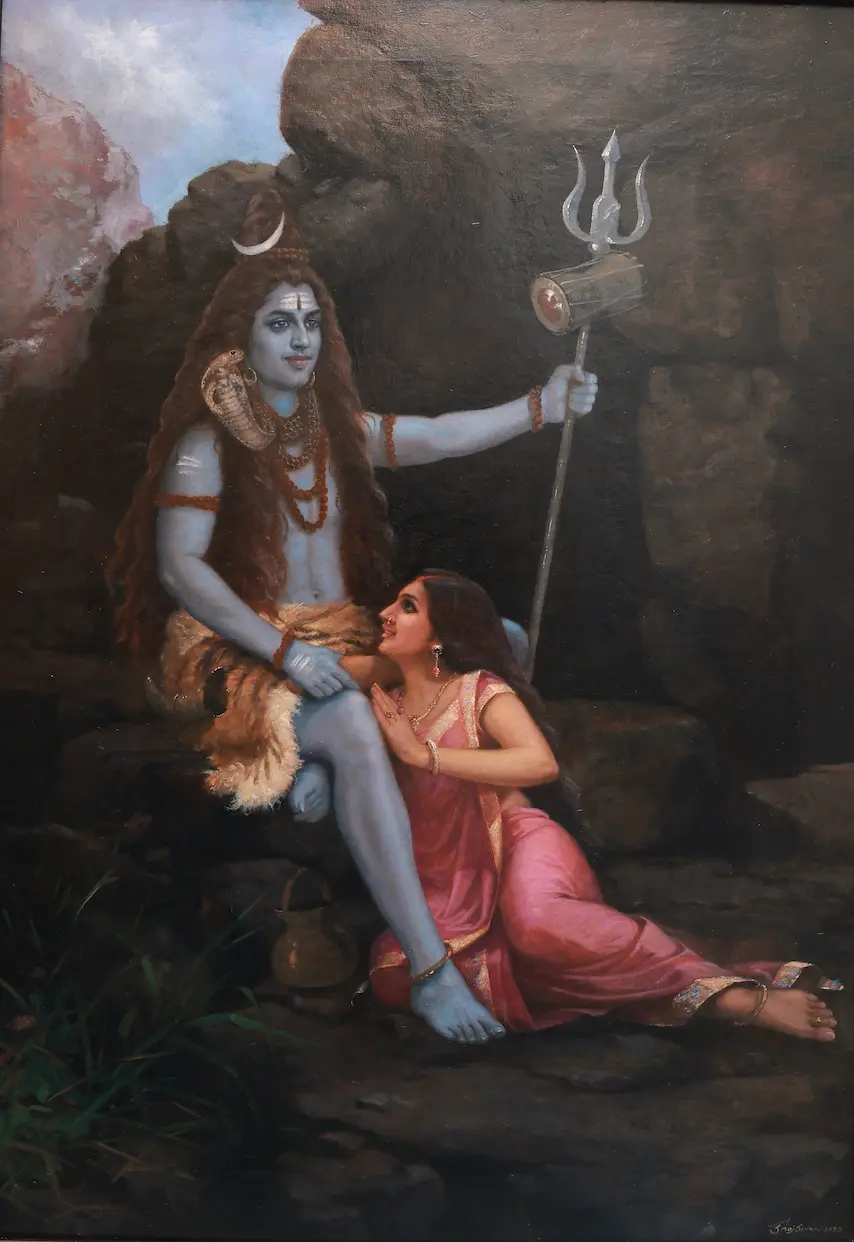
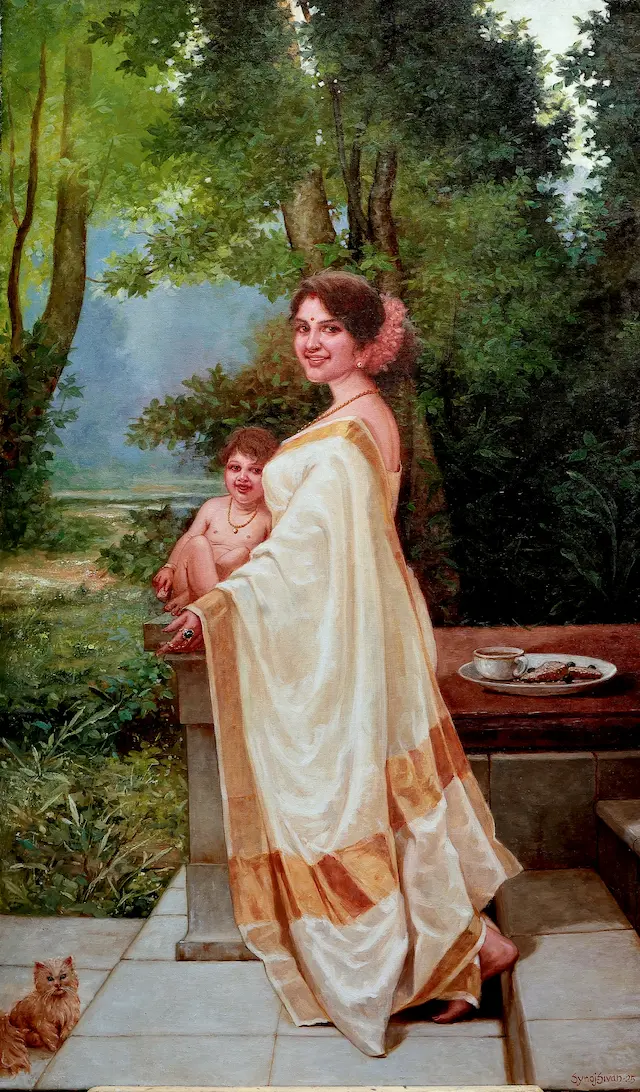
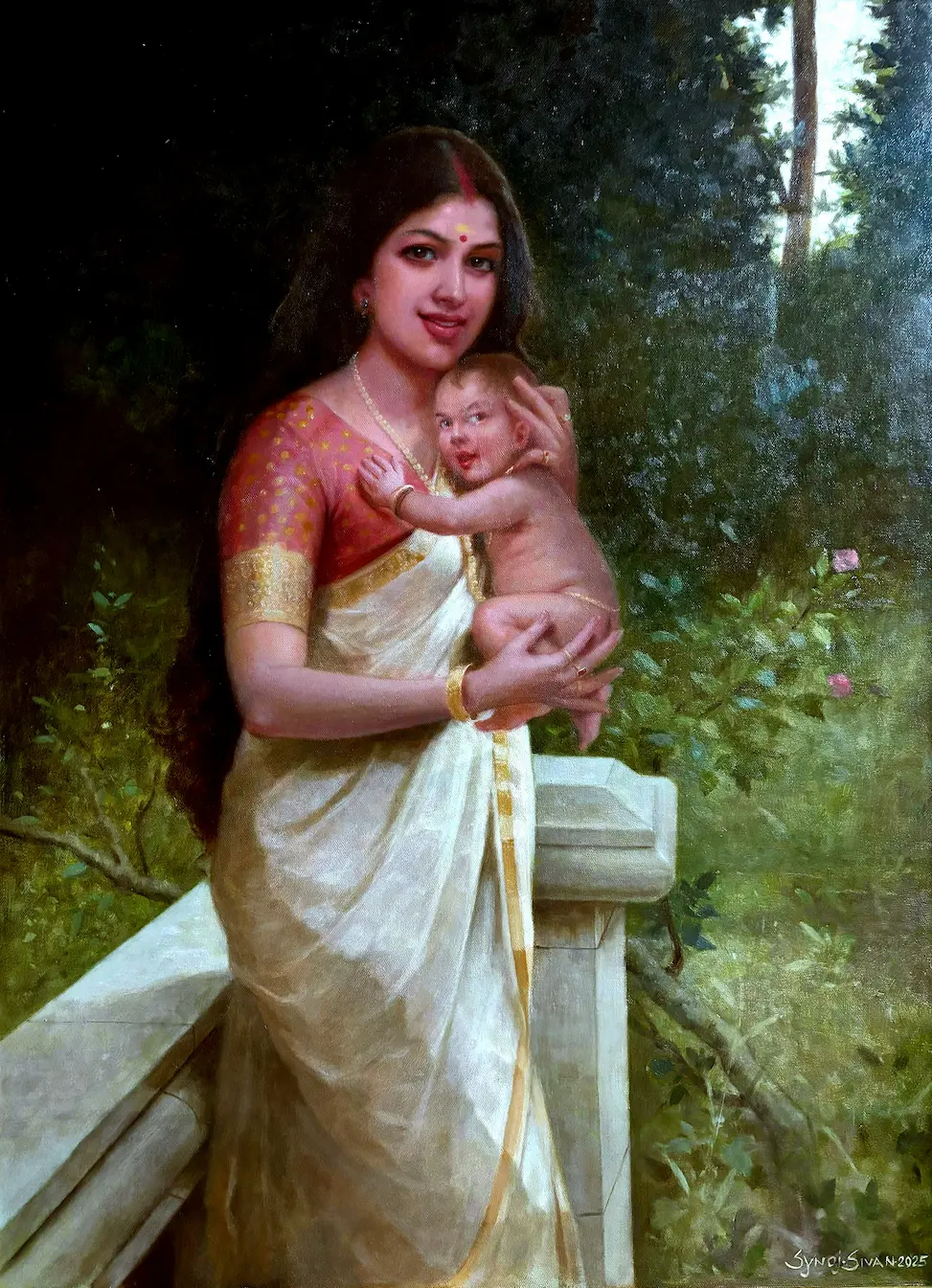
The decades that followed built on that foundation steadily. His works entered the catalogues of Christie’s London and Sotheby’s, the two most prestigious auction houses in the world, reaching collectors and institutions whose engagement with an artist represents the highest form of market validation. Exhibitions followed across Kerala, Delhi, Bangalore, Kochi, and Trivandrum, and then far beyond India’s borders: London, France, Germany, Turkey, Canada, Kenya, and other international destinations where audiences encountered his paintings without the cultural context that might be assumed at home, and responded with the same recognition that great art tends to produce regardless of geography.
THE CRAFT: REALISM AS A SPIRITUAL DISCIPLINE
Synoj Sivan describes painting as both an art and a science, a characterisation that captures something essential about how he approaches the canvas. The scientific dimension is visible in his technical precision: the intricate detailing of fabric and jewellery, the rendering of skin tones that carry the warmth of Kerala light, the compositional balance that holds complex mythological scenes together without sacrificing their emotional charge. These are not accidental effects. They are the product of disciplined study and the kind of patient attention that turns a gift into a mastery.
The artistic dimension is equally demanding. His subjects require not just technical accuracy but emotional truth. A painting of Shiva and Parvathi is not merely an exercise in figure composition. It is an attempt to make visible the quality of a divine relationship that has been understood and felt by hundreds of millions of people across centuries. The challenge is to bring something new to a subject saturated with meaning, to find a detail, an expression, a quality of light that makes a familiar story feel freshly experienced. It is a challenge Synoj Sivan meets with a consistency that has defined his reputation.
SRI MOOKAMBIKA DEVI: THREE YEARS, ONE MASTERPIECE
Among all of Synoj Sivan’s works, Sri Mookambika Devi occupies a singular place. Completed between 2009 and 2012, the painting required three years of sustained effort, a commitment of time and devotion that says as much about the artist’s character as it does about his craft. The work now resides in the Mookambika Temple Museum, a home that gives it both a sacred context and an enduring audience of visitors who come to the temple carrying precisely the kind of feeling the painting was made to honour.
The painting is widely regarded as the fullest expression of his ability to hold realism and spirituality in balance. The technical achievement is undeniable, but what gives the work its power is the devotional sincerity visible in every decision, from the quality of the goddess’s gaze to the handling of the divine light that surrounds her. It is a painting that does not merely represent a deity. It aspires to make the divine presence felt. That aspiration, pursued with three years of disciplined attention, is the clearest statement of what Synoj Sivan’s art is ultimately for.
FROM MYTHOLOGY TO EVERYDAY LIFE: THE FULL RANGE OF A PAINTER’S VISION
While his mythological works have earned him his widest recognition, Synoj Sivan’s range is considerably broader than a single theme. His paintings of Indian rural and urban life, including works like The Malabar Lady, Going to Temple, Mother with Baby, and Making Ayurveda Medicine, demonstrate a painter equally at home with the textures of ordinary Indian existence. These are not lesser works. They carry the same technical rigour and the same instinct for the meaningful detail that elevates a scene from documentation to art.
Alongside these, his signature creations, Lady with Swan, The Pearl, Queen of Heart, and Wisdom, show yet another dimension: a more contemplative, symbolic mode in which the figure becomes a vehicle for ideas about beauty, knowledge, and the interior life. Together, the full body of his work describes a painter who has used the technical apparatus of Western academic realism entirely in service of Indian cultural identity, building a visual language that is at once internationally fluent and unmistakably rooted.
AWARDS AND RECOGNITION: A CAREER VALIDATED AT EVERY LEVEL
The honours Synoj Sivan has received reflect both the breadth and the depth of his impact. The Art Maestro International Exhibition Award in Delhi, the World Wide Art Movement Award in Kochi, the Mega International Art Exhibition Award in Gujarat, and the International Painting Exhibition Gold Medal in Delhi speak to his standing within formal institutional frameworks. The Kalaratna Award of India in 2020 and recognition by the High Range Book of World Records add further dimensions to that picture.
Most significantly, the M.F. Husain Award of India in 2024 places him in the lineage of India’s most celebrated visual artists. M.F. Husain, one of the most iconic figures in modern Indian art, was himself a painter deeply engaged with mythology and cultural identity. To be recognised through an award bearing his name is to be acknowledged as a legitimate heir to that tradition, a painter who has extended its possibilities rather than simply repeated its gestures.
A CULTURAL AMBASSADOR IN OIL AND CANVAS
The phrase cultural ambassador is used often enough to have lost some of its precision, but in Synoj Sivan’s case it describes something real and specific. His paintings have introduced audiences in London, Paris, Istanbul, Toronto, and Nairobi to aspects of Indian visual and spiritual culture that no diplomatic briefing or tourism campaign could convey. Art reaches past the conceptual into the experiential, and a painting of Krishna and Radha executed with the full resources of academic realism communicates something about the feeling of Indian devotion that words, even very good ones, struggle to match.
His presence on television, including appearances on Amrita News, Asianet News, and Kerala Vision, has extended that ambassadorship to broader domestic audiences, while his participation in international art discussions and press engagements positions him as a voice within the global conversation about the relationship between traditional art forms and contemporary practice. For emerging artists navigating the tension between cultural inheritance and international recognition, his career offers both a model and an encouragement.
THE ONGOING STORY: PAINTING INDIA FOR THE WORLD
A career that began with a twelve-year-old and watercolours in Kerala, that passed through a solo international exhibition at eighteen, that produced a three-year devotional masterpiece now housed in a temple museum, and that has placed canvases in two of the world’s most prestigious auction houses, is not a career that invites easy summary. What unifies it is something simpler and more durable than any individual achievement: a consistent commitment to the belief that painting can carry culture, that realism can serve spirituality, and that the stories India has been telling for thousands of years are worth telling again, with new skill and new devotion, for audiences who may be encountering them for the very first time.
Synoj Sivan continues to paint. And in each new work, the same intention is present: to make the invisible visible, to bring the mythological into the real, and to remind anyone who stands before the canvas that beauty and meaning, when held together in a single image, have a power that nothing else quite replicates.