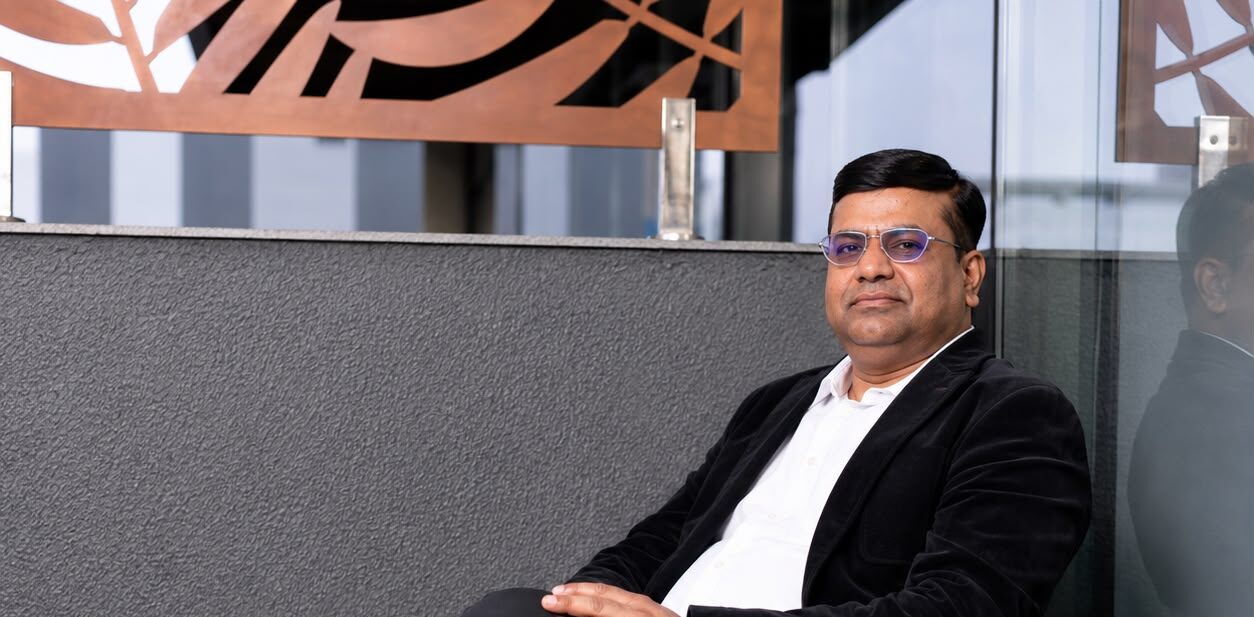
Not every entrepreneurial story begins with a market opportunity. Some begin with a conviction so deep and so long-held that founding a company becomes the only logical conclusion.
For Dr. Surendra Takawale, that conviction formed across three decades of working at the frontlines of one of the most critical challenges of the 21st century: water security. His career spanned municipal, industrial, and infrastructure sectors, leading projects that transformed how organizations manage water and wastewater resources. He worked with advanced treatment technologies. He led large-scale project execution. And through all of it, he arrived at a conclusion that would not leave him alone.
India needed a new generation of water enterprises, ones capable of combining innovation, sustainability, and execution excellence in a way the existing landscape was not delivering. That realization became Blue Zone Ventures.
“Our mission is simple yet ambitious,” he says. “To help industries, cities, and communities create a future where water is reused, recycled, and managed as a strategic resource rather than a consumable commodity.”
It is a mission that begins with engineering and ends with a fundamental shift in how society values what flows through its pipes.
INDIA’S WATERSHED MOMENT
The picture Dr. Takawale paints of India’s water future over the next decade is both urgent and genuinely optimistic. The country, he believes, is approaching a watershed moment in the most literal sense of the phrase.
The shift he anticipates is from water consumption to water circularity. Wastewater reuse, smart water networks, desalination, decentralized treatment systems, and AI-enabled operations will move from the experimental to the mainstream. The measure of a city or an industry will expand beyond how much water it consumes to how effectively it recovers and reuses what it has already used.
India, he is clear, has both the talent and the policy momentum to become a global benchmark in sustainable water management. The question is not whether the transformation will happen. It is whether the organizations and institutions involved will build the right infrastructure to make it happen at the scale and speed the challenge demands.
Blue Zone Ventures exists to help answer that question practically, on the ground, project by project.
THE GAP BETWEEN CREATION AND OPERATION
Naming the challenge clearly is the first step toward addressing it honestly. Dr. Takawale identifies the most significant pressures facing the water sector today with the directness of someone who has encountered each of them in practice: aging infrastructure, rising water stress, stricter environmental regulations, and a persistent gap between infrastructure creation and sustainable long-term operation.
That last challenge is one he returns to with particular emphasis. Many water facilities are built successfully. The technical execution of construction is completed on schedule and within budget. And then, over time, long-term performance deteriorates because the operational sustainability dimension was never given equal weight during the design and delivery phase.
At Blue Zone Ventures, the response to this pattern is built into the business model. Solutions are designed to deliver measurable outcomes across the entire lifecycle of a project, not just at the ribbon-cutting moment. Technology, execution, and operational sustainability are treated as equally important dimensions of every engagement.
SUSTAINABILITY AS FOUNDATION, NOT FUNCTION
In many organizations, sustainability occupies a dedicated department with its own budget, its own reporting lines, and its own annual targets. At Blue Zone Ventures, Dr. Takawale has deliberately refused that structure.
Sustainability, in his framework, is not a department. It is the foundation of the business philosophy itself. Projects are designed to maximize water recovery, minimize energy consumption, reduce environmental impact, and create long-term value simultaneously. The underlying objective is to demonstrate, through actual project outcomes, that sustainability and profitability are not competing priorities but complementary ones.
“We design projects that prove sustainability and profitability can coexist,” he says. It is a proposition he tests against real outcomes rather than asserting as an aspiration.
THE CONVERGENCE THAT CHANGES EVERYTHING
Among the technological developments shaping the water sector, Dr. Takawale is most energized by the convergence of artificial intelligence, the Internet of Things, predictive analytics, and advanced treatment technologies. Together, these forces are creating something that was not possible even a decade ago: smart treatment plants capable of self-optimization and predictive maintenance.
The implications are significant. Operators will be able to make faster and better-informed decisions while simultaneously reducing costs and improving reliability. The reactive model of water infrastructure management, in which problems are addressed after they surface, will give way to a predictive model in which issues are identified and resolved before they affect performance.
This is the operational future Dr. Takawale is building toward, and it is one where the gap between what technology makes possible and what India’s water infrastructure actually delivers can finally begin to close.
LEADERSHIP SHAPED BY OXFORD AND IIM AHMEDABAD
Dr. Takawale’s educational experiences at Oxford and IIM Ahmedabad shaped dimensions of his leadership that reach beyond technical expertise. Both institutions reinforced the importance of lifelong learning, strategic thinking, and evidence-based decision-making. More significantly, they deepened a belief about what leadership itself actually is.
Leadership, in his understanding, is fundamentally about empowering people, building trust, and creating organizations capable of sustaining excellence beyond the tenure of any individual leader. The mark of a well-led organization is not dependence on its founder’s continued presence. It is the capability and culture that remain after the founder steps back.
That understanding shapes how he builds his team, how he structures Blue Zone Ventures, and how he thinks about the legacy his work will leave in India’s water sector.
THE CASE FOR PUBLIC-PRIVATE PARTNERSHIP
On the role of public-private partnerships in India’s water future, Dr. Takawale is unequivocal: they are not optional. They are indispensable.
Government agencies bring vision, policy direction, and the institutional authority to set standards and enforce compliance. Private organizations bring innovation, technology, and the execution capabilities to translate policy intent into real infrastructure outcomes. Neither succeeds as well without the other.
The greatest opportunities for partnership, in his view, lie in wastewater reuse, urban water resilience, smart infrastructure, and industrial sustainability initiatives. These are the areas where the complexity of the challenge and the scale of the investment required make collaboration between public and private actors not just beneficial but essential.
WHAT THREE DECADES OF ENTREPRENEURSHIP TEACHES
Distilled from a career that has spanned large-scale project execution and the founding of a new kind of water enterprise, Dr. Takawale’s entrepreneurial lessons are earned rather than borrowed.
Credibility, he has learned, is built through consistent delivery, not through claims. Innovation earns its place only when it solves practical problems rather than generating theoretical elegance. And resilience is often the decisive difference between ventures that succeed and those that do not. Entrepreneurship, in his characterization, is not about avoiding challenges. It is about developing the capability to navigate them while remaining focused on a purpose larger than any individual obstacle.
His advice to future entrepreneurs and engineers in the sector carries the same clarity: choose challenges that matter, build real expertise, maintain integrity under pressure, and commit to continuous learning. The water sector offers something rare: the opportunity to combine genuine business success with genuine societal impact.
A VISION LARGER THAN ANY SINGLE PROJECT
Looking at 2026 and the years beyond, Dr. Takawale’s strategic priorities for Blue Zone Ventures reflect the ambition that has defined his career from the beginning. Expanding advanced water and wastewater solutions. Accelerating digital transformation. Strengthening operation and maintenance capabilities. Driving large-scale water reuse initiatives that contribute meaningfully to India’s national water security agenda.
The vision behind those priorities is captured in the belief that has guided everything he has built.
“Water security will define the sustainability and economic resilience of nations in the 21st century,” he says. “Our responsibility is not merely to treat water, but to transform how society values, conserves, and reuses it. The future belongs to organizations that view every drop as an opportunity for innovation and impact.”


In that single sentence lives thirty years of experience, a founding conviction, and a blueprint for what comes next.