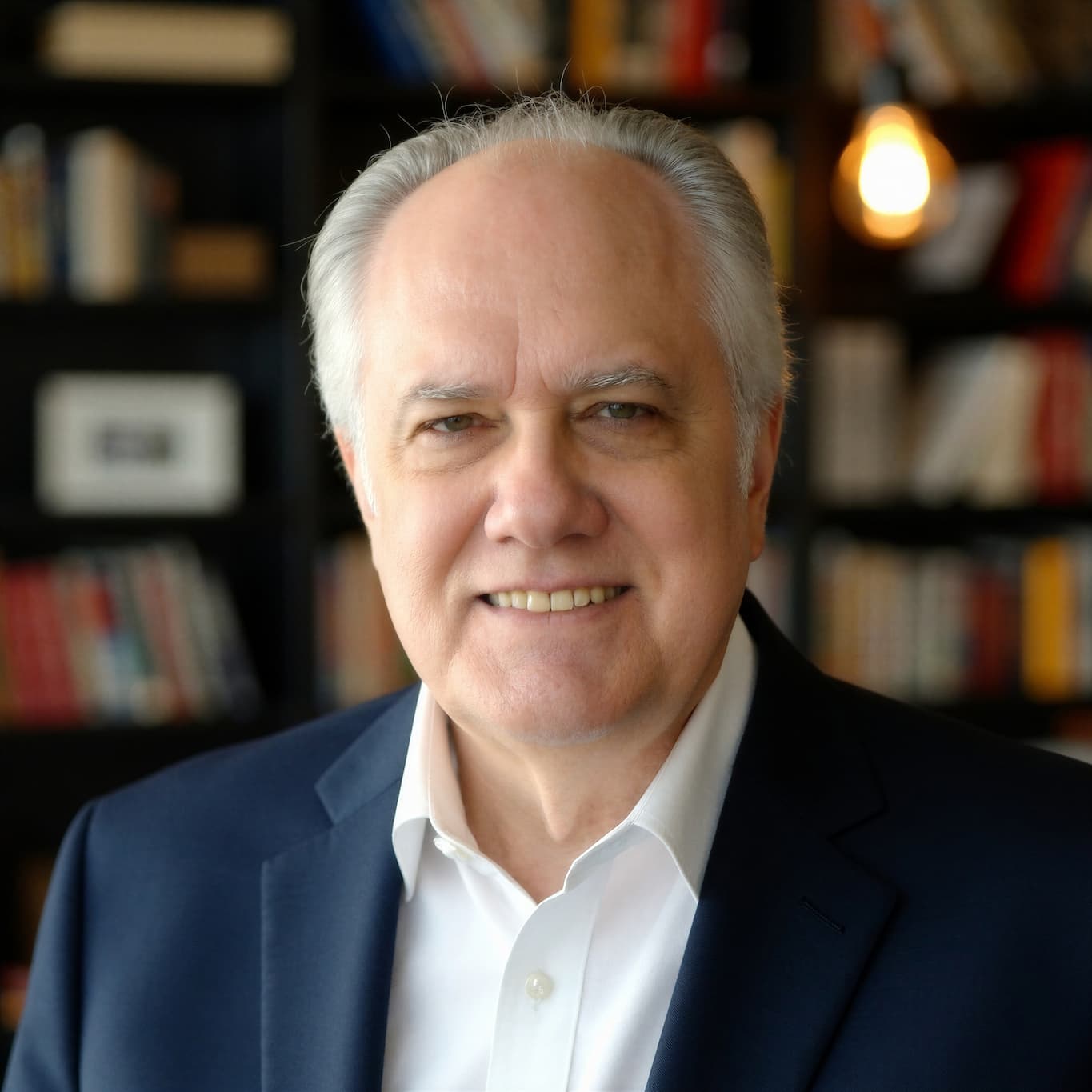
There are financial experts who understand markets. And then there are the rare visionaries who understand that behind every market movement, sovereign portfolio, pension structure, and institutional balance sheet lies something far greater than numbers alone: human stability, economic resilience, and the future security of societies.
For more than four decades, Dr. Jerome Kreuser has operated precisely at that intersection.

As the Founder and CEO of RisKontroller Global LLC, Dr. Kreuser has become one of the most respected minds in quantitative finance, sovereign risk management, dynamic stochastic optimization, and institutional portfolio intelligence. Long before concepts like the “Total Portfolio Approach” became central to global institutional investing, he was already designing sophisticated frameworks capable of integrating uncertainty, liabilities, long-term risk, and human-centered financial decision-making into unified analytical systems.
What distinguishes Dr. Kreuser is not simply his mastery of mathematics or financial modelling. It is the philosophy driving his work.
“I was born a mathematician and an empathic humanitarian,” he explains. “Optimization became my way of applying mathematics to improve systems that ultimately benefit people.”
That sentence captures the essence of an extraordinary career dedicated not merely to advancing finance, but to making global financial systems smarter, safer, and more resilient.
THE JOURNEY: FROM MATHEMATICS TO GLOBAL FINANCIAL IMPACT
Dr. Kreuser’s path began with a deep fascination for mathematics and optimization theory. Graduating with honours in mathematics before earning advanced degrees in theoretical mathematics, optimization, and numerical analysis, he built the intellectual foundation that would later influence central banks, sovereign wealth funds, multinational institutions, and global financial organizations.
Throughout his academic journey, he collaborated with globally recognized scholars including Rosen, Mangasarian, Wets, Ziemba, and Didier Sornette, shaping his multidimensional understanding of optimization, risk analytics, and dynamic systems. Yet unlike many purely theoretical researchers, Dr. Kreuser remained deeply committed to practical applications.

“We live in a time unprecedented having almost immediate access to all the knowledge of the world through AI.”
His early realization was profound: finance represented one of the most powerful environments where optimization could directly improve institutional resilience and human outcomes simultaneously.
That conviction eventually led him to the World Bank, where he would spend 24 transformative years helping redefine how large institutions approached risk, portfolio management, and economic modelling.
BUILDING THE FOUNDATIONS OF MODERN RISK INTELLIGENCE
At the World Bank, Dr. Kreuser founded the institution’s internal quantitative analysis consulting group and developed innovative portfolio management systems for the Treasury Department at a time when advanced stochastic modelling was still far from mainstream adoption. He was fortunate to work with Lester Seigel in the Treasury Department on several problems and together outside of the World Bank up to today.
But his contributions extended well beyond treasury operations.
He contributed to major World Development Reports, developed optimization models for healthcare systems using disability-adjusted life years (DALYs), designed industrial optimization frameworks for China’s fertilizer infrastructure, worked on steel plant optimization initiatives, and developed sophisticated cash flow modelling systems for Saudi Arabia.
The consistent pattern across all these projects was clear: Dr. Kreuser was never interested in mathematics for abstraction alone. His focus was always on creating analytical systems capable of solving real-world institutional challenges.
Among his most visionary contributions was his early work in dynamic asset–liability optimization under uncertainty an approach decade ahead of the broader financial industry. Today, the institutional finance world widely recognizes these integrated frameworks as the “Total Portfolio Approach,” but Dr. Kreuser had already been pioneering these methodologies more than forty years earlier.
“Institutional risk management is different for everyone,” he explains. “Every institution and every individual requires a unique approach. That flexibility became central to the systems I designed.”
REDEFINING SOVEREIGN RISK AND GLOBAL PORTFOLIO STRATEGY
As Dr. Kreuser’s reputation grew internationally, his expertise became increasingly sought after by central banks, sovereign wealth funds, reinsurers, pension systems, and global financial institutions across Europe, Asia, Latin America, and the Middle East.
His work with the Reserve Bank of India, State Bank of India, the Central Bank of Jordan, Swiss pension funds, Credit Suisse, Swiss Re, Renaissance Re, and the Bank for International Settlements established him as one of the leading global authorities on sovereign and institutional risk modelling.
One of the defining achievements of his career came during a BIS, ECB, and World Bank conference in Frankfurt in 2008, where he presented an advanced dynamic stochastic programming model for Norway’s Sovereign Wealth Fund.
The model incorporated multi-currency assets, oil revenues, foreign exchange fluctuations, drawdown controls, and complex policy constraints over a 17-year horizon extending to 2025.
What followed became one of the most remarkable demonstrations of long-term quantitative forecasting accuracy in sovereign finance.
The projected expected value generated in 2008 came within a fraction of a percent of the fund’s actual realized value in 2025.
For Dr. Kreuser, this achievement reinforced the importance of combining long-term and short-term risk factors, adaptive parameter modelling, and probabilistic distribution shaping into integrated decision-making systems.
FINANCIAL BUBBLES, AI, AND THE NEXT FRONTIER OF FINTECH
Another major chapter of Dr. Kreuser’s journey emerged through his collaboration with Professor Didier Sornette at ETH Zürich. Together, they developed advanced bubble identification frameworks incorporating the Kelly Criterion, extending bubble detection models across different markets, time horizons, and financial environments.
Their research demonstrated that tipping points in asset prices and financial instability can often be identified directly through market price movements themselves, creating opportunities for institutions to proactively reduce exposure before crises fully materialize.
Today, Dr. Kreuser continues expanding these frameworks through AI-integrated financial modelling under the RisKontroller Global platform. He has expanded RisKontroller operations by partnering with Robert Shumaker, head of Bifrost Quest Capital for his vast experience in quantitative research and portfolio management.
He believes artificial intelligence represents one of the most transformative opportunities in modern finance, offering unprecedented access to global knowledge, behavioural insights, and analytical power. Yet he also emphasizes that AI must remain aligned with human advancement and responsible decision-making.
“We live in a time unprecedented,” he says. “AI gives us access to nearly all the knowledge of the world. We must use that gift to promote and improve humanity.”
LEADING THROUGH KNOWLEDGE, EDUCATION, AND GLOBAL COLLABORATION
Beyond institutional consulting and research, Dr. Kreuser has also built a remarkable educational legacy.
He served as Adjunct Professor at George Washington University, succeeding Professor Garth McCormick in graduate optimization coursework, while also teaching advanced courses at the Universities of Illinois and Wisconsin.
Across Germany, Singapore, Malaysia, India, Jordan, Spain, Colombia, Peru, and Switzerland, he conducted workshops and executive education programs focused on advanced asset–liability management, sovereign risk strategy, and institutional portfolio resilience.
Despite the complexity of his work, Dr. Kreuser has always believed that true mastery lies in simplicity and clarity.
He frequently references Richard Feynman’s famous principle:
“If you can’t explain it to a child, you don’t understand it yourself.”
That philosophy has guided his ability to bridge the gap between sophisticated mathematical frameworks and practical institutional decision-making.
A LEGACY BUILT ON RESPONSIBLE FINANCIAL INNOVATION
When reflecting on his career, Dr. Jerome Kreuser consistently returns to one central idea: finance should ultimately serve humanity.
Throughout decades of innovation in quantitative finance, sovereign risk, portfolio optimization, and AI-driven financial analytics, he has remained committed to designing systems that strengthen institutional resilience while improving long-term societal outcomes.
His work stands as a rare combination of academic rigor, mathematical brilliance, practical global experience, and deeply human-centered thinking.
In a world increasingly shaped by volatility, geopolitical uncertainty, AI transformation, and systemic financial complexity, leaders capable of integrating science, strategy, ethics, and resilience may become more valuable than ever before.
Dr. Jerome Kreuser belongs to that rare category of visionaries shaping not only the future of institutional finance, but the future conditions under which global financial systems will remain trusted, sustainable, and resilient for generations to come.