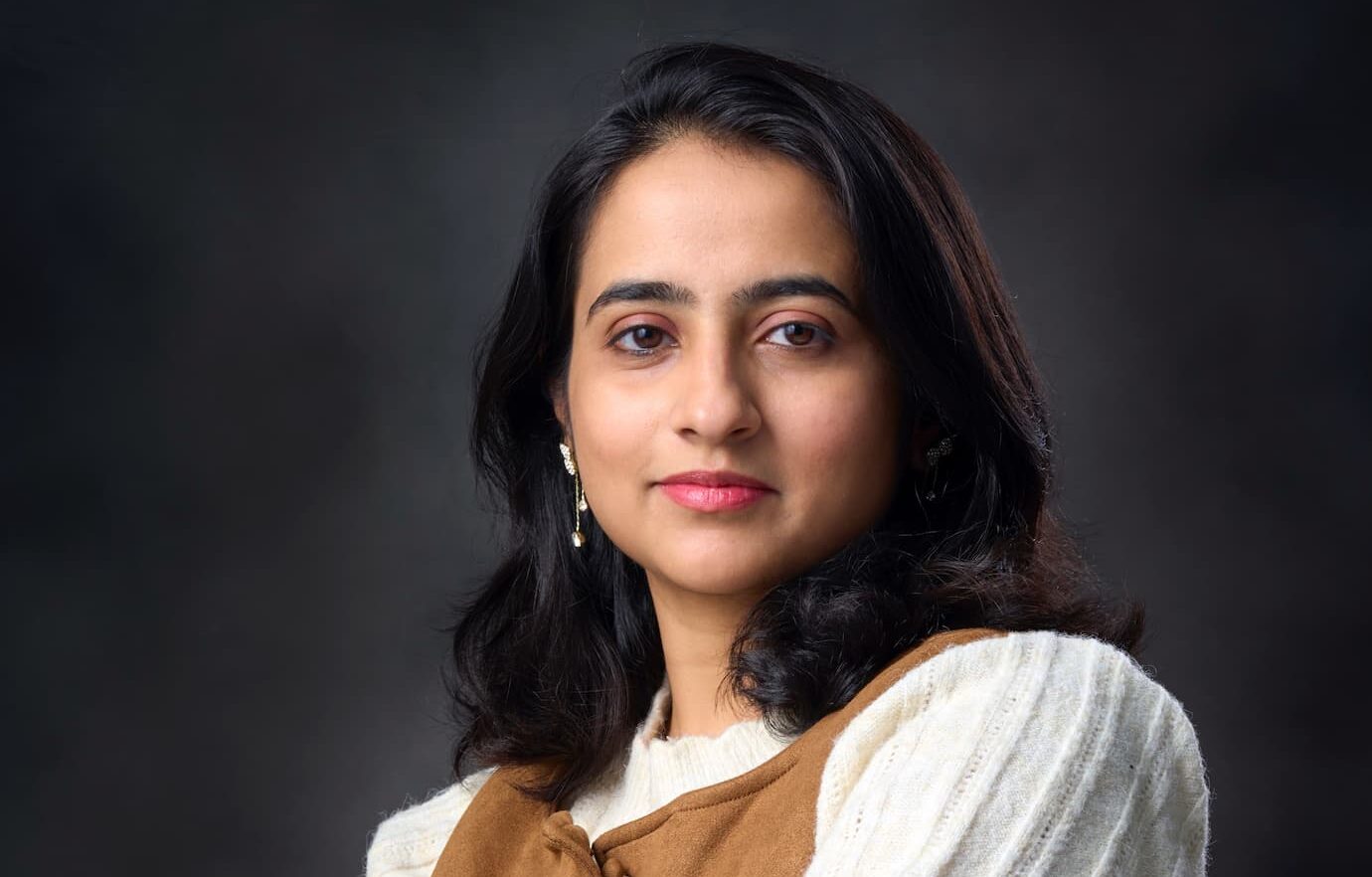
In a world increasingly dominated by algorithmic imagery and digital saturation, Samruddha Purekar stands as a guardian of something rare: the human hand’s ability to translate presence into permanence. Working under the name Samruddhartè, she has spent years refining a practice that refuses the dramatic in favor of the profound, choosing restraint over spectacle, and depth over immediacy.
Her canvases do not shout. They whisper. Yet within that whisper lies an entire philosophy of artistic practice, one that emerged not from calculated branding but from organic evolution. “Samruddharte comes from my own name, Samruddha, which means abundance, combined with arte,” she explains. “It was never chosen deliberately as a brand name. It emerged naturally as my practice evolved.”
For Samruddha, abundance does not mean excess. It means depth: depth of observation, patience, discipline, and emotional honesty. When there is richness within, the work finds its own balance without being forced. This understanding has become the foundation of everything she creates, from intimate portraits to large-scale commissions, from academic research to teaching the next generation of artists.
FORMATION THROUGH OBSERVATION: THE SCULPTOR’S INFLUENCE
Every artist can trace their practice back to a formative encounter, a moment when the seeds of lifelong pursuit were planted. For Samruddha, that moment arrived through watching her husband, sculptor Kishor Purekar, work. “Watching him form a portrait from a lump of clay within hours left a deep impression on me,” she recalls. “That immediacy stayed with me.”
But immediacy, she would learn, is not the same as haste. Over time, her interest moved beyond technical likeness toward something more elusive: presence itself, particularly as it manifests in the eyes. “They carry silence, memory, and truth,” she observes. “That quiet exchange continues to draw me back to portraiture.”
This evolution from surface accuracy to emotional resonance defines her entire approach. Where many portraitists focus on capturing external features, Samruddha seeks the internal landscape, the accumulated experience that shapes a gaze, the weight of unspoken histories that settles around a mouth or across shoulders. Her subjects do not perform for the viewer. They simply exist, held in a moment of contemplative stillness.
THE ARCHITECTURE OF IMPRESSION: TRANSLATING VISUAL MEMORY
Samruddha’s creative process defies conventional narrative construction. She does not sketch preliminary stories or plan symbolic elements. Instead, her work emerges from accumulated visual impressions that linger long after the initial encounter. “Visual impressions stay with me even when I am not painting: a shaft of light on a sofa, a statue in a corner, a plant, or light touching metal,” she explains. “These moments linger for days. Slowly, they form abstract relationships and quiet harmonies.”
When she finally approaches the canvas, what emerges is not a constructed story but a translation of these impressions, a visual poetry that resists literal interpretation. This approach places her work in conversation with the impressionist tradition while maintaining a distinctly contemporary sensibility. Light, form, and emotional temperature become her vocabulary, speaking in a language that bypasses narrative convention to arrive directly at feeling.
ACADEMIC FOUNDATIONS: WHERE INTUITION MEETS DISCIPLINE
Samruddha’s formal training at Shreemati Nathibai Damodar Thackersey Women’s University proved crucial in shaping her artistic voice. Much of her Master’s training unfolded through alla prima practice at the old SNDT Churchgate campus, where she developed an essential skill: the ability to observe quickly and respond honestly.
“I often invited students from other departments to pose, which trained me to observe quickly and respond honestly,” she remembers. But technical practice represented only one dimension of her education. “Time spent in the library was equally important. Long hours in the Fine Arts section grounded my intuitive practice in history, continuity, and discipline.”
This balance between immediate response and deep historical understanding would become characteristic of her entire approach. She learned that spontaneity without foundation produces shallow work, while research without intuitive response creates academic exercises rather than living art.
DOCTORAL RESEARCH: REDEFINING ALLA PRIMA PRACTICE
Samruddha holds a PhD focused on the Alla Prima Narrative Impressionist style, research that fundamentally reshaped her understanding of this painting approach. The transformation began in the library, where she encountered Richard Schmid’s writings. “I realised it is not a rushed painting process,” she explains. “It requires preparation, sometimes days spent simply understanding the canvas before the first stroke.”
Studying pigments, color temperature, edges, and brushwork revealed the hidden discipline within what appears spontaneous. This inquiry later formed the foundation of her doctoral research, allowing studio practice and academic study to inform one another. The result is work that appears effortless but emerges from years of accumulated knowledge and hundreds of preparatory sketches.
Daily sketching remains central to her practice, keeping ideas flowing naturally while reinforcing fundamental skills. This commitment to continuous learning distinguishes her approach from artists who rely solely on established techniques.
THE QUIET BALANCE: INSTINCT INFORMED BY RESEARCH
How does an artist balance scholarly research with intuitive expression? For Samruddha, the answer lies in internalization. “Research remains quietly within me,” she says. “When I begin painting, instinct takes over, trusting that preparation has already shaped my decisions.”
Over time, she has learned that less is often more. True clarity comes through simplicity. This understanding allows her work to remain emotionally alive while maintaining structural strength. Technical knowledge does not constrain expression but liberates it, providing a secure foundation from which intuition can operate freely.
The portraits that emerge from this balance possess an unusual quality: they feel both immediate and timeless, spontaneous yet considered. Viewers sense the years of preparation that enable each brushstroke while experiencing the work as a unified emotional statement rather than an assembly of technical decisions.
PORTRAITURE IN THE AGE OF ARTIFICIAL INTELLIGENCE
Samruddha positions her practice within broader conversations about art’s role in an increasingly digital world. With artificial intelligence advancing rapidly, she believes preserving originality created by human hands has become essential. “Art must carry emotion and feeling, not just outward appearance,” she insists.
She observes a thoughtful Indian audience increasingly recognizing that living spaces feel incomplete without genuine art. Indian art is now seen beyond stereotypes, drawing strength from emotional sensitivity and strong line traditions. “I try to honor this lineage within a contemporary context,” she explains.
This perspective acknowledges technology’s capabilities while asserting art’s irreplaceable qualities: the accumulated decisions, the physical touch, the human presence embedded in every brushstroke. Where algorithms optimize for pattern recognition, human artists create meaning through emotional resonance and cultural memory.
TECHNOLOGY AS TOOL, NOT REPLACEMENT
Despite her emphasis on handmade artistry, Samruddha actively incorporates digital tools into her creative process. She uses the iPad for compositional analysis and works with CNC and 3D printing for ongoing sculpture projects that require contemporary fabrication methods. “Technology supports precision and scale, but it never replaces the physical act of making,” she clarifies.
Nothing, she insists, replaces the act of painting itself. “The fragrance of linseed oil and pigments carries the calm of a fresh jasmine garland, familiar and grounding.” This sensory dimension of artistic practice, the embodied knowledge that comes through repeated physical engagement with materials, cannot be digitized or automated.
Her approach demonstrates how contemporary artists can engage technology strategically without surrendering the essential qualities that distinguish human creativity. Digital tools serve planning and structural thinking, while the actual creation remains resolutely analog, preserving the irreplaceable connection between hand, eye, and material.
INNOVATION THROUGH RESTRAINT: THE EMOTIONAL ARCHITECTURE
Samruddha’s innovations happen quietly, through subtle shifts rather than dramatic gestures. She experiments with surface preparation, minute adjustments in color temperature, and careful handling of edges so that faces do not feel imposed upon their backgrounds. “These choices may appear technical, but they directly influence emotion,” she notes.
When materials respond sensitively, expressions soften and stillness emerges. She avoids dramatic effects, allowing restraint to guide the process so that emotion surfaces gently and honestly. This approach requires confidence and discipline, resisting the temptation toward obvious impact in favor of nuanced resonance.
Innovation and experimentation allow her to approach each portrait without formula, ensuring that technical choices serve emotional truth rather than stylistic consistency. The result is work that feels individually considered rather than produced according to house style.
MATERIAL RESPONSIBILITY: PERMANENCE AS ETHICAL COMMITMENT
For Samruddha, experimentation extends beyond immediate visual effects to encompass long-term material integrity. She has spent years researching papers, linens, pigments, and varnishes. Every material choice is guided by stability and longevity. “When someone invests in my work, it should endure across time and climate without the need for corrective intervention,” she explains.
This commitment represents an ethical dimension of artistic practice often overlooked in contemporary discourse. Creating work that will deteriorate or require extensive conservation interventions betrays the trust collectors place in artists. Emotional depth, for her, is inseparable from responsibility toward materials.
The hundreds of hours spent researching archival practices, testing grounds, and evaluating pigment stability never appear in the finished work. Yet they ensure that today’s emotional resonance will remain accessible to future generations, that the investment collectors make preserves not just current value but enduring presence.
WRITING AS CLARIFICATION: ORGANIZING CREATIVE THOUGHT
Samruddha recognizes writing and research as essential to strengthening artistic practice. “Writing helps organize thought into mental maps that quietly guide decisions while painting,” she explains. This clarity allows her to work calmly even with bold forms, strong values, and precise color temperatures.
Few realize how many years of research and hundreds of sketches exist quietly before a resolved body of work appears. The visible painting represents only the final manifestation of extensive invisible preparation. Writing serves as a bridge between intuitive response and deliberate intention, helping articulate insights that might otherwise remain inchoate.
This intellectual dimension of her practice distinguishes her approach from purely intuitive methods. Thought and feeling inform one another, creating work that satisfies both emotional and intellectual engagement. Viewers respond not just to surface beauty but to the deeper coherence that emerges when artistic decisions align across multiple dimensions.
JEHANGIR MOMENT: WHEN PRACTICE MEETS PUBLIC
Exhibiting at Jehangir Art Gallery marked a significant milestone in Samruddha’s career. Working alone in the studio rarely offers immediate response to completed work. At Jehangir, something different happened. Viewers approached her deeply moved, some recalling childhood memories, others confronting personal experiences through her portraits.
“Standing there for seven days, feet tired, simply waiting to connect, felt worthwhile,” she recalls. Selling works on the spot brought quiet confidence and lasting friendships. The feedback book from that exhibition still occupies a place in her studio, a tangible reminder of those connections.
These encounters confirmed what years of solitary practice had suggested: that work created with emotional honesty and technical integrity resonates across different viewers’ experiences. The portraits became mirrors not through literal representation but through emotional authenticity, allowing viewers to recognize themselves in unfamiliar faces.
BOLD AND BEAUTIFUL: THE PARADOX OF STRENGTH
The exhibition Bold & Beautiful celebrates strength and expression, themes that align perfectly with Samruddha’s artistic journey. Yet her interpretation of these terms differs from conventional understanding. “Boldness and sensitivity have always coexisted in my practice,” she observes. “Sometimes the idea is bold and the execution restrained. Sometimes the medium itself reveals temperament.”
For her, boldness is clarity, and beauty lies in restraint. This understanding has made the journey peaceful, defining both her personal practice and her brand identity as Samruddhartè. She rejects the false opposition between strength and subtlety, demonstrating that the most powerful statements often arrive through whispers rather than shouts.
This philosophy extends beyond individual works to shape her entire approach to career development. She does not seek constant visibility or maximum production. Instead, she trusts sustained practice over time, allowing depth to accumulate through patient attention rather than aggressive self-promotion.
TEACHING AS TRANSMISSION: NURTURING NARRATIVE VOICE
As an art educator, Samruddha encourages emerging artists to find their own narrative voice through practical engagement with art history. She recommends museum visits whenever possible, bringing those experiences back into the studio where learning becomes tangible. Revisiting old sketches helps students understand consistency and growth.
The challenge, she recognizes, is staying committed to fundamentals: drawing, observing, and sketching despite demanding schedules. Contemporary art education often emphasizes conceptual development at the expense of technical foundation. She advocates for balance, ensuring students develop both the skills to execute their visions and the conceptual frameworks to give those visions meaning.
Teaching also reinforces her own practice, requiring her to articulate insights that might otherwise remain intuitive. Explaining why certain decisions matter, how different approaches produce different effects, and what distinguishes successful work from unsuccessful attempts deepens her own understanding while helping students navigate their artistic development.
INTERSECTION POINTS: NAVIGATING MULTIPLE ROLES
Balancing home, motherhood, teaching, research, and artistic creation has been challenging. These competing demands taught Samruddha discipline and clarity, forcing her to identify what truly matters and eliminate what does not. Another ongoing challenge is remaining grounded after achievements and staying a student despite professional success.
Although commissions are in high demand, she deliberately restricts her practice to a small number each year to protect depth, sensitivity, and lasting material integrity. This decision represents a fundamental choice: prioritizing quality over quantity, long-term reputation over short-term income, and emotional authenticity over market demands.
The intersection of multiple roles, rather than fragmenting her identity, has enriched her practice. Motherhood deepens her understanding of presence and observation. Teaching clarifies her thinking. Research provides historical context. Each dimension informs the others, creating a more complex and nuanced artistic voice than would emerge from studio practice alone.
LOOKING FORWARD: QUIET CONTRIBUTION ON A GLOBAL STAGE
Samruddha envisions contributing quietly and meaningfully to Indian art on a global stage through sustained practice and teaching. Her work is moving toward long-term, thoughtfully scaled commissions that allow depth, continuity, and responsibility, whether intimate or large in scale.
She does not seek constant visibility, trusting instead that sustained practice over time will build lasting recognition. This patient approach stands in stark contrast to contemporary pressures for continuous social media presence and viral visibility. She believes quality work eventually finds its audience through organic discovery rather than aggressive marketing.
Most importantly, she wishes to remain a little childlike, because it is this innocence that keeps the work genuinely abundant. This aspiration speaks to her deepest artistic values: approaching each canvas with fresh eyes, maintaining wonder at light’s behavior, staying open to surprise despite accumulated expertise.
THE ABUNDANCE OF RESTRAINT
Samruddha Purekar’s career demonstrates that contemporary artistic practice can honor traditional values while engaging modern contexts. Her work bridges academic research and intuitive expression, technical mastery and emotional authenticity, Indian artistic traditions and global contemporary discourse.
Through Samruddhartè, she has created not just a body of work but an artistic philosophy: one that recognizes abundance in depth rather than excess, finds strength in restraint rather than drama, and values sustained practice over momentary visibility. Her portraits do not demand attention. They invite contemplation, rewarding patient observation with gradually revealed complexity.
As artificial intelligence reshapes creative landscapes and digital tools proliferate, Samruddha’s practice asserts the irreplaceable value of human touch, accumulated knowledge, and emotional honesty. Her canvases carry what algorithms cannot replicate: the trace of a hand guided by years of preparation, the mark of decisions made through sensitivity rather than optimization, the presence of an artist fully committed to her materials and their enduring integrity.
The future she envisions, quiet contribution rather than loud proclamation, reflects her deepest understanding: that genuine abundance requires nothing more than honest work, sustained over time, created with care for both immediate resonance and lasting presence. In a world of increasing noise, Samruddhartè speaks in whispers. And those who listen discover worlds.