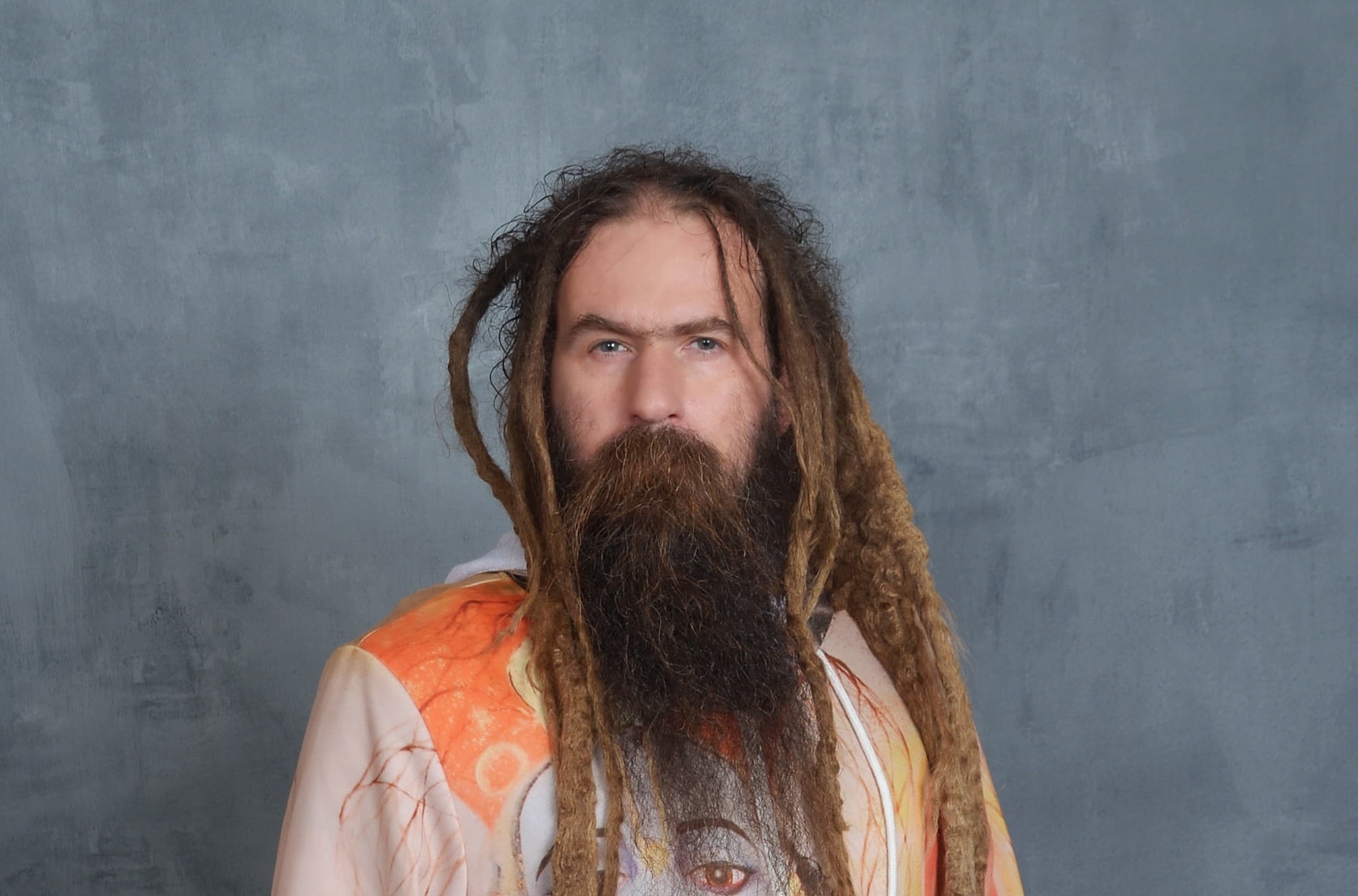
In a world where children abandon creativity for conformity, Brian C. Baker made a different choice at school recess: he chose to draw over play. This simple decision would set in motion a lifetime journey through the labyrinth of consciousness, where art becomes the bridge between the seen and unseen dimensions of existence.
The foundation of Baker’s artistic calling was laid by his father, who preserved his sophisticated teenage portfolio and transformed their childhood bedroom walls into canvases for famous cartoon characters. “My Dad taught me the pleasure of drawing,” Baker recalls, describing how these early encounters with visual storytelling would shape his destiny. The family’s Saturday morning cartoon obsession led young Brian to a pivotal discovery at the local mall bookstore, where he encountered the fantasy art of Boris Vallejo and the mythological landscapes of Dungeons & Dragons simultaneously.
This convergence of popular culture and mythological imagery would prove prophetic. Guided through gifted and talented programs and eventually to college scholarships, Baker’s path seemed clear. Yet the journey from promising art student to visionary painter would require navigating what he describes as “a rocky transition through early self-discovery, embraced personal narrative, and finally crafting a vision of artistic and spiritual cosmology.”
THE LANGUAGE OF SYMBOLS: TRANSLATING THE DIVINE
Baker’s artistic process transcends conventional creativity. He operates in what he calls “the language of symbols,” channeling lucid dreams and waking visions of deities that he describes as startlingly real. “Some would say these are archetypes in the Jungian sense, but even Jung felt there was a part of the human mind outside the sphere of space and time,” Baker explains.
I would like anyone who finds themselves by the side of my artistic mirror to see it for themselves that they too are of the Divine or even the divine one themselves
His approach to capturing these profound encounters challenges traditional artistic methodology. “It is a kind of magic to really embody and channel such things into the physical realm of visual art. Perhaps it is okay to use the word miracle in some cases.” Whether depicting peaceful goddesses, wise all-powerful lords, or more ambiguous entities, Baker serves as a conduit for forces that transcend ordinary imagination.
The authenticity of these visions sets them apart from mere creative visualization. “Such encounters transcend imagination for their clarity and impact is undeniable, while many other thought forms are difficult to hold onto,” he notes. For Baker, meditation and visualization are helpful tools, but they are not the source. “The gods wish to be known and seen. This is my opinion. Art can be like an avatar.”
SPIRITUAL AWAKENING: THE HAND OF THE DIVINE
Baker’s spiritual journey began before he consciously recognized it. Raised Christian but sensing something deeper, he describes experiencing “like a hand in mine, a veiled presence showing my young mind little glimpses of itself.” During adolescence, he witnessed two bright eyes in the starry sky of his mind, initially interpreting this vision as “a genie or gypsy spirit” rather than understanding its divine nature.
Years later, these mysterious eyes revealed themselves as God Krishna or Sarasvati Devi, the goddess of art and knowledge. This recognition sparked what Baker calls “a long period of awakening in my early twenties, an extended initiation or trip of colorful enlightened consciousness. This drove my art making.”
The spiritual foundation of his work was confirmed through a prophetic early drawing of “a light blue and lavender hand brushing through hair of monarch butterflies.” When he later encountered the book Sri Isopanishad with Keshava on the cover, Baker realized that “the beauty of God had inspired me before I had ever seen it.”
THE UNIVERSAL UNIVERSITY: DISCOVERING DIVINE COSMOLOGY
Baker’s formal spiritual education began through Iskcon Krishna books and paintings, leading him to meet Astara, described as “a walk-in soul with fiery eyes” who introduced him to Swami Shankarananda. This guru taught from what Baker calls “a universal church of absolute monism,” encompassing the Bible, Buddhist Dhammapada, and the Bhagavad Gita.
This inclusive approach opened doors to interconnected lineages spanning multiple traditions. A dream about a Tantric Goddess guided him toward Shakta and Shaiva paths, while his guru’s connection to Yogananda and Mahavatar Babaji’s lineage provided access to what Baker was told was “the Universal University of the Universe.”
This comprehensive spiritual education informs every aspect of Baker’s artistic vision, creating works that synthesize Eastern and Western mystical traditions within a cohesive cosmic framework.
THE CHALLENGE OF SCALE: CURATING THE INFINITE
Baker’s artistic output presents unique logistical challenges. Having created hundreds of canvases, many on massive scales requiring custom stretchers and frames, he faces the practical reality that “it’s simply impractical to move many giant and heavy and fragile artworks all at once.” Some pieces remain rolled like giant scrolls due to their extraordinary length, while others exist on wooden boards that defy conventional display methods.
His curation process revolves around “this overarching theme of Godhead Shri Krishna and his entourage of associates, Avatars, and demigods and goddesses.” Rather than arbitrary groupings, Baker seeks to “portray a relationship between all characters as well as them to we viewers,” creating narrative connections that transform individual pieces into components of a larger cosmic story.
The scale serves a specific purpose beyond mere visual impact. Baker creates his works “big enough for a small family to gather together in front of. Vast yet intimate.” This approach allows both individual absorption and group philosophical discussion, facilitating different levels of engagement with the divine themes.
THE MUSE-OM VISION: A MODERN TEMPLE OF ART
Baker’s ultimate artistic vision extends beyond individual paintings to encompass what he calls the MUSE-OM, a museum-like labyrinth designed to present his works in their intended context. Inspired by Ernst Fuchs, who headed the Austrian School of Fantastic Realism from his mansion-turned-museum, Baker envisions “a permanent showcase of important works installed in narrative format through a series of spacious halls, intimate enough to enjoy each but vast enough to take the whole in at once.”
This concept represents more than exhibition space; it embodies Baker’s understanding of art as spiritual architecture. “It’s a modern vision of an ancient temple,” he explains, acknowledging that Krishna Ashrams already demonstrate this universal concept while pursuing his own unique interpretation.
The labyrinth metaphor is intentional, reflecting Baker’s belief that encountering divine art should be a journey of discovery rather than passive observation. Like Salvador Dali, H.R. Giger, and Alex Grey, who have created immersive artistic environments, Baker seeks to construct a space where visitors can experience his cosmic narrative as a complete revelation.
BALANCING REALITY AND FANTASY: THE PARADOX OF TRUTH
Baker’s approach to fantastic realism navigates the complex relationship between imagination and deeper truths. “Fantasy of imagination has no boundaries but the deep truth of realism is defined by its limits. This can be flipped on its head as a paradox,” he observes, acknowledging the philosophical complexity of his artistic challenge.
His resolution comes through surrender to divine will rather than personal artistic control. “I think I yield to the rules when the rules do not bend. The rules bend to their will not to mine. They are God’s rules.” This approach recognizes that different spiritual paths may operate under different rules, but underlying principles of morality and love remain constant.
The balance emerges naturally through what Baker describes as “fluidity between the hemispheres of the brain, which work together unopposed. If it is not already balanced it cannot be forced.” This organic integration allows his work to embody mystical realism where hidden truths within existence become visible through artistic revelation.
COMMUNION AND CONTEMPLATION: THE VIEWER’S JOURNEY
Baker’s intended impact on viewers extends beyond aesthetic appreciation to spiritual transformation. “Communion. Contemplation. Inspiration. Awe,” he lists as desired responses, emphasizing the communal aspect of his large-scale works that can accommodate multiple viewers simultaneously.
His artistic philosophy positions the viewer as participant rather than observer. “I’ve used myself as a human example in the pictures to represent all humans relating to God and the gods,” Baker explains. This approach invites viewers to see themselves within the divine narrative, recognizing their own spiritual potential and connection to cosmic consciousness.
The ultimate goal transcends artistic experience to achieve spiritual realization. “I would like anyone who finds themselves by the side of my artistic mirror to see it for themselves that they too are of the Divine or even the divine one themselves.” This vision positions art as a tool for self-recognition and spiritual awakening rather than mere entertainment or decoration.
THE TESTAMENT PAINTING: KRSNA DATTATREYA
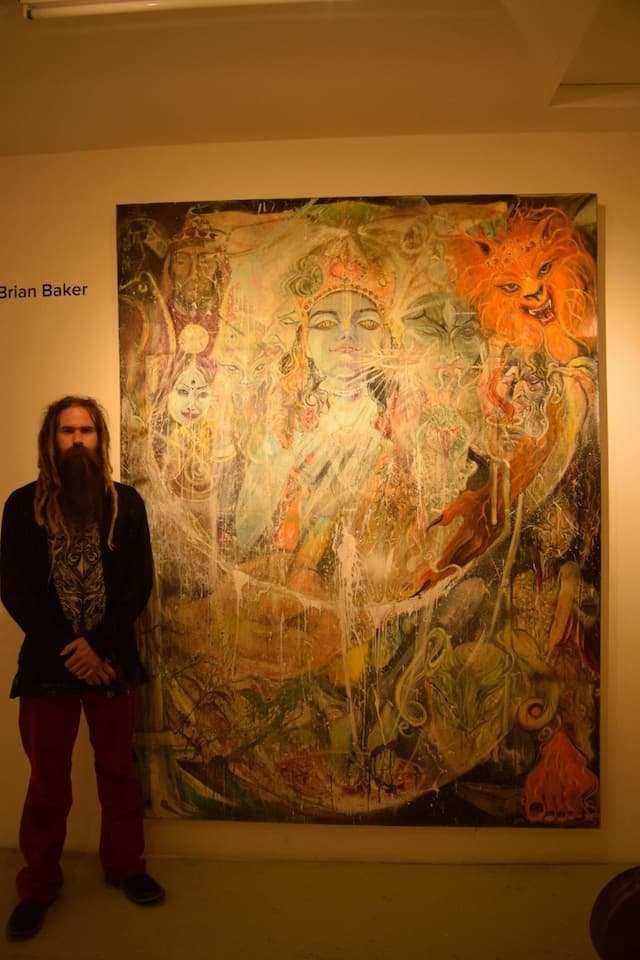
Among Baker’s extensive body of work, one painting holds particular significance: KRSNA or Sri Krishna Dattatreya, a 6×8 foot canvas completed fresh out of art school. “I put everything I had into it and yet have learned much much more in the thirty years which have passed. All the other important paintings originate with that one.”
This seminal work represents Baker’s artistic and spiritual manifesto, integrating multiple religious traditions within a unified cosmological vision. “It was my testimony to initiation into the spiritual and mystic mysteries of the Hindu and Buddhist paths with a nod to my own Christian upbringing.” The composition places Krishna as supreme deity while incorporating the trimurti of Brahma and Shiva with their Shaktis, Western representations of divine and demonic forces, and even extraterrestrial elements indicating cosmic significance.
The painting demonstrates Baker’s sophisticated theological synthesis, using “a portrait of Pan to minimize the devilish jinn Iblis or Satan while representing Jesus as a self-portrait in the lap of God.” This careful integration of potentially conflicting religious imagery reflects his understanding of universal spiritual principles underlying diverse traditions.
THE CREATIVE ORDEAL: FROM VISION TO CANVAS
Baker’s creative process involves what he describes as an overwhelming journey from initial vision to completed work. The transition from entheogenic theophanies to physical painting requires “a struggle of many sketches and notes taken wildly for several days, making sure I do not forget anything or at least leaving room for new ones to emerge and be incorporated.”
The actual painting process becomes a ritual transformation that Baker compares to pregnancy and labor. “I feel pregnant and even go through a kind of unpleasant symptoms to leave the world behind me and treat the work like a ritual of rebirth or of dying to an older self.” This intense engagement with the creative process reflects his understanding of artistic creation as spiritual practice.
The completion brings renewal through ordeal. “Then the fluidity ensues and I reemerge refreshed by the ordeal. Only to do it again and again.” This cyclical pattern of spiritual death and rebirth through artistic creation positions Baker’s work as both personal transformation and divine service.
ART AS UNIVERSAL LANGUAGE: BRIDGING COMMUNITIES
Baker views art as a powerful force for cultural and spiritual understanding that transcends traditional boundaries. “Faiths, professions, nationalities, etc. are all one. No man is an island,” he observes, positioning artistic expression as a universal language capable of communicating what words often cannot.
His experience with religious iconography illustrates this principle. While Christian art allows recognition of Jesus across cultures, Baker notes that Krishna’s tradition provides even more specific divine revelation: “Art has carried down through traditions what Jesus Christ looks like, to some extent, but because it is a different tradition with a different focus it’s not quite the same thing as having Godhead Krishna tell you exactly how he looks like.”
This understanding positions artists as cultural translators and spiritual messengers. “If another’s art shows me what is on their mind, indeed a picture is worth a thousand words.” Baker’s work attempts to serve this bridge function, making Eastern spiritual concepts accessible to Western audiences while honoring the authenticity of both traditions.
INFLUENCES AND INSPIRATION: THE NETWORK OF TEACHERS
Baker’s artistic and spiritual development draws from a diverse network of influences spanning family, formal teachers, fellow artists, and divine sources. Beyond his father’s initial guidance and art teachers Kuhlman and Jasper, he acknowledges shamanic colleagues Tisa, Ras Rob, Ras Atiba, Kirby and Voke, artistic masters Ernst Fuchs, Alex Grey, H.R. Giger, and Salvador Dali.
His intellectual framework incorporates writers like Richard Maurice Bucke, author of “Cosmic Consciousness,” and Norman Paulsen, who wrote “Christ Consciousness” after studying with Yogananda. These thinkers helped Baker understand his experiences within broader traditions of mystical awakening and artistic expression.
The spiritual lineage proves most complex, stemming from his guru Swami Shankarananda’s library and teachings that “lead me very far into the interconnected web of Sages.” This web ultimately connects to Krishna Chaitanya while incorporating controversial figures and texts that Baker acknowledges as part of his complete spiritual education.
SUSTAINING THE VISION: DEVOTION THROUGH THE DECADES
At 50, Baker acknowledges that maintaining his artistic output presents new challenges. “I will admit it is more difficult. I paint less because of worldly responsibilities but feel it in my blood, spirit, and bones; it’s a devotional discipline, a need to commune with God the muse of muses.”
His production has naturally slowed from creating large-scale pieces every few months in his youth to one or two per year currently. However, this reduction in quantity reflects a deeper understanding of artistic practice as spiritual discipline rather than mere productivity.
Baker’s perspective on artistic sustainability emphasizes being over doing. “One realizes at some point that life is about the human being, not the things a human can do or has to do. So enjoying being. That is the challenge, the art of life.” This wisdom positions artistic creation within the larger context of spiritual development and self-realization.
GUIDANCE FOR EMERGING ARTISTS: THE PATH OF AUTHENTIC EXPRESSION
Baker’s advice to emerging artists seeking to infuse spirituality into their work emphasizes authentic commitment over superficial technique. “Identify with your heroes. Know your stuff; whatever you believe or seek, your faith. Never give up or into criticism against your convictions.”
His guidance stresses total engagement with the artistic spiritual path. “Put all your gut and soul into it, your training, your inspiration, your fight as Krishna tells Arjuna in Bhagavad Gita. Stay the course, commit to it like a marriage, feed it, it feeds you.”
The balance between spiritual practice and artistic craft requires individual discernment. “If you need to focus on Sadhana do that, if you need to focus on artistic craft do that, and try to merge the two with all you’ve got.” Most importantly, Baker emphasizes self-care as foundational to authentic artistic expression: “The teaching often overlooked is to be as good to oneself as to others.”
LEGACY AND THE FUTURE: DIVINE CONNECTION IN A DIGITAL AGE
Despite the possibilities offered by digital publishing and reproduction, Baker maintains his commitment to the physical MUSE-OM vision. “The MUSE-OM may be a pipe dream but hopefully not! In this digital age we can publish much… But I’m not giving in. I want it all.”
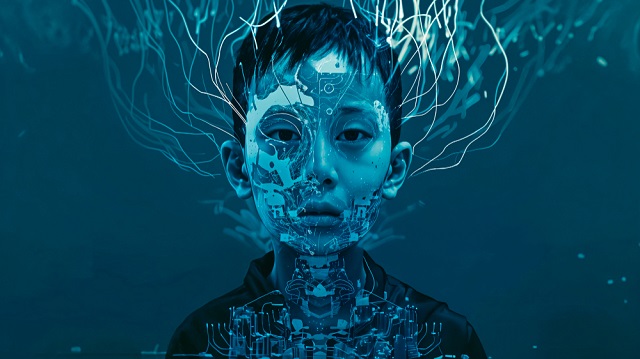
His perspective on artificial intelligence reveals deep concern about humanity’s relationship with technology. “Artificial intelligence is not the ally of the painter, unless that’s your path.” Baker advocates for maintaining divine connection over technological dependence: “We have a divine connection unlimited by technology. The technology of the soul and brain are more powerful than computers in one way at least; God made them.”
This stance reflects his broader vision of art as essentially human and spiritual. “We are not meant to be alien to ourselves and one another. My labyrinth of the soul belongs to God, not technology.” Baker’s legacy vision prioritizes authentic spiritual connection over technological innovation or commercial success.
THE ETERNAL CANVAS: ART AS SPIRITUAL TESTIMONY
Brian C. Baker’s journey from childhood sketches to monumental spiritual paintings represents more than artistic achievement; it embodies a complete integration of creative expression with mystical realization. His work challenges viewers to recognize their own divine nature while bridging Eastern and Western spiritual traditions through the universal language of visual symbolism.
Baker’s understanding of myth as mithya, drawing from Devdutt Pattanaik’s interpretation of ancient Hindu wisdom, positions his art as essential windows to truth. Through “hundreds of thousands of incomplete and flawed symbols and words,” his paintings attempt to capture “the infinite perfection and boundlessness of sat.”
As Baker continues his artistic journey, his example demonstrates that authentic spiritual art requires complete commitment to both technical mastery and divine surrender. His vision of the labyrinth museum remains not just an artistic goal but a spiritual necessity, a sacred space where humanity can encounter the divine through the transformative power of visionary art.
The legacy Baker seeks to create transcends individual artistic achievement to establish a new model for spiritual artistic practice in the modern world. His work stands as testimony that true art serves not the artist’s ego but the divine source from which all creativity flows, inviting viewers to recognize their own participation in the cosmic dance of creation and consciousness.